






The Practitioner-Builder EraPart 1
The Rise of the Practitioner-Builder
What happens when the people who understand a problem best finally have the tools to solve it themselves?
- Joshua Cleopas
- Category
- AI
- Date
- 21 Oct 2026
- Read
- 9 min
- Views
- 0
- Text size


In this article
- The problem with running a business on ten different applications
- I wasn’t trying to build a software company
- Sometimes the smallest problems are the most valuable
- The people closest to the problem
- I thought I was building something just for myself
- What happens when more practitioners start building?
- Are we approaching a different relationship with software?
I’ve been thinking about something lately.
I think we’re witnessing the emergence of a new kind of software creator. And interestingly, many of these people aren’t software developers.
They’re filmmakers, designers, teachers, accountants, architects, entrepreneurs, and people who spend their days working in industries that have very little to do with software development.
What they have in common isn’t necessarily an interest in technology.
It’s that they have problems.
Problems they’ve experienced so frequently that, in many cases, they’ve simply learned to live with them.
And now, with AI, some of these people are beginning to do something they previously couldn’t.
They’re building their own solutions.
I call them practitioner-builders.
And I think they could change how software gets created.
The problem with running a business on ten different applications
Let me use my own experience as an example.
I run a creative company from Ghana. And like many business owners, I’ve spent a ridiculous amount of time trying to find software that makes running the company easier.
There’s Notion, Zoho Books, Monday.com, and several other platforms we use for different aspects of the business.
Individually, these are useful applications. They solve real problems, and they’re often very good at what they do.
But here’s the thing.
My business doesn’t operate as ten separate departments that never interact.
Our projects, finances, employees, clients, creative production, and equipment are all connected.
Yet the software managing them often isn’t.
I’d find myself jumping between applications to understand something that should have been straightforward. And as the company grew, the problem became even more frustrating.
Every new employee needed to learn how to use multiple platforms. Every additional subscription increased our operating expenses. And running a company from Ghana meant those subscription costs could be especially painful, particularly when paying in foreign currency.
But I think the bigger problem was the friction.
We were spending so much time managing the tools that were supposed to make our work easier.
At some point, I started asking myself a question.
What if I could bring everything into one place and make it work exactly the way my company operates?
A few years ago, that would have been a difficult question for me to answer.
I’m not a software developer by training. Building an integrated business management platform would have meant hiring developers, explaining our workflows, budgeting for development, and probably spending considerable time getting the details right.
So, like most business owners, I would likely have continued adapting.
But AI gave me another option.
I started building.
I wasn’t trying to build a software company
This is the part I find interesting.
I didn’t start with a business plan for a new software product.
I wasn’t researching the SaaS market or looking for an opportunity to compete with established software companies.
I just wanted my business to run better.
So I began building a platform around the problems I was experiencing every day.
And because I understood those problems firsthand, I could be very specific about what I needed.
Take our creative review process, for example.
Previously, a designer would finish a design and send it to me on WhatsApp.
I’d review it, identify changes, and try to explain exactly what needed fixing.
Sometimes it was a font. Sometimes it was an image. Sometimes it was a tiny detail in a particular corner of the design.
Explaining these things through messages could be frustrating.
The designer might misunderstand what I meant. I’d explain again. They’d make another change. We’d go back and forth until we finally understood each other.
And once the work was approved, someone still had to manually send it to the client.
It worked.
But it wasn’t particularly efficient.
Now, our review process happens inside the platform I built.
A designer uploads their work as Version 1. I can draw directly on the design, circle elements, underline sections, and leave comments exactly where changes are needed.
The designer receives the feedback in the same system.
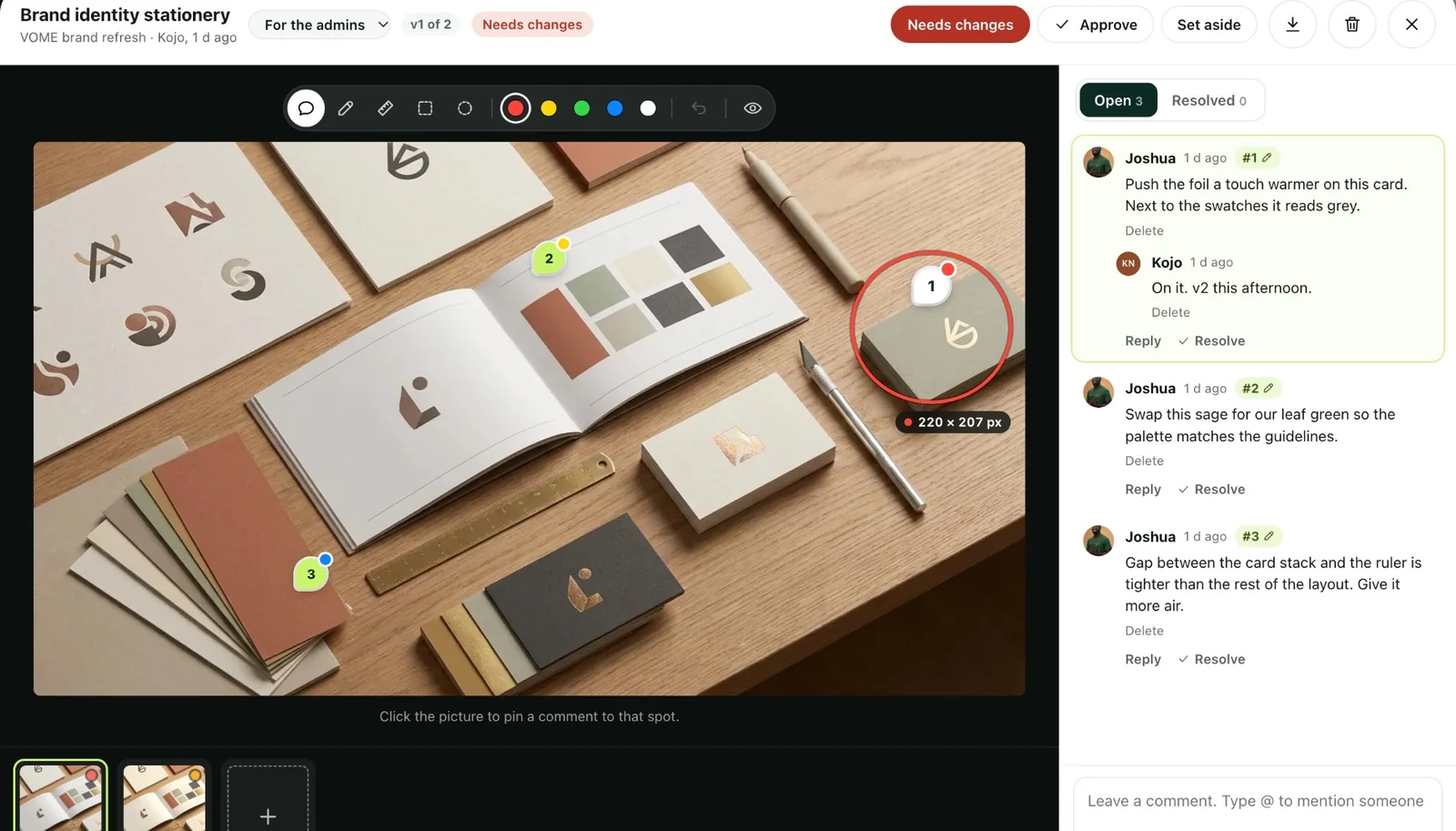
When they upload the revised work, it’s automatically categorized as Version 2.
Once the design is approved, the system can send it directly to the client by email.
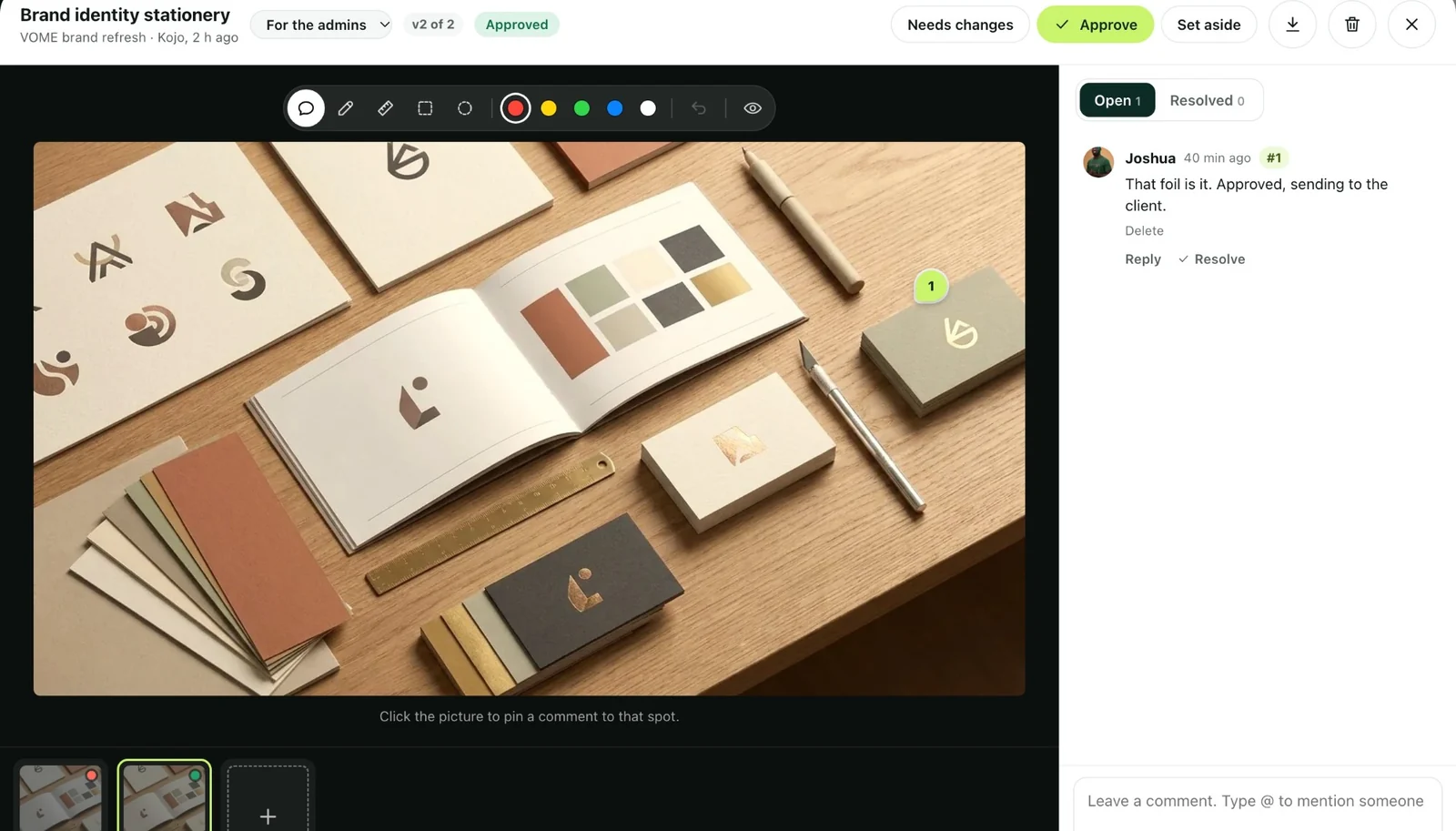
That alone has saved us approximately four hours of review work across a project.
But I wanted to solve another problem.
Sometimes the person responsible for reviewing work is simply unavailable.
And when that happens, projects sit there waiting.
So I built AI-assisted reminders and escalation into the workflow.
If a designer submits work and I haven’t reviewed it after an hour, the system reminds me.
If I send feedback and the designer hasn’t acted on it, the system can remind them too.
And if I’m unavailable for three hours after a submission, the review can be escalated to our project manager, who also has approval authority.
The work doesn’t have to stop simply because I’m busy.
This wasn’t some revolutionary invention.
It was a solution to a very ordinary problem that had been costing us time.
And that’s precisely my point.
Sometimes the smallest problems are the most valuable
The review system is just one example.
We also have an equipment inventory system that tracks cameras, lenses, and other production gear.
Previously, friends and colleagues would borrow equipment, and we’d occasionally struggle to remember who had what or when it was supposed to return.
Now we can generate equipment request links, record borrowers and their intended locations, and track expected return dates.
Then there’s our financial dashboard.
Instead of constantly switching between bank statements, accounting software, and expenses recorded elsewhere, I can bring the information into one place.
I can see income, expenses, expected payments, and projections for the coming months.
Information that once required searching through different applications, messages, and records is now much easier to access.
None of these features is necessarily groundbreaking on its own.
Equipment management software already exists. Design review applications exist. Financial dashboards exist.
But I didn’t need three more disconnected products.
I needed these capabilities to work together, around the way we actually operate.
And I knew exactly what those workflows looked like because I was living with their limitations every day.
That brings me to what I think is the real significance of AI-assisted software development.
The revolution isn’t simply that software is becoming easier to build. It’s that the distance between experiencing a problem and solving it is shrinking.
The people closest to the problem
Traditionally, when someone in an industry identifies a problem that requires software, they often have to explain that problem to someone who can build the solution.
A restaurant owner explains their operations to a developer.
A filmmaker explains their production workflow.
A school administrator explains how their institution manages students, staff, and payments.
The developer then translates those explanations into software.
There’s nothing inherently wrong with this process. Good developers, designers, and product teams have built remarkable products by understanding the needs of people in different industries.
But there’s something difficult about explaining a problem you’ve experienced for years.
Sometimes the small details are hard to articulate.
Sometimes you’ve developed so many workarounds that you don’t even recognize them as workarounds anymore.
And sometimes, the person building the solution simply doesn’t experience the problem the way you do.
I think AI is beginning to change that relationship.
A practitioner can now experiment with building a solution directly, test it against their real workflow, discover what doesn’t work, and refine it.
They don’t need to communicate every detail perfectly before anything can be built.
They can discover the requirements through the process of building.
This doesn’t mean domain expertise automatically replaces technical expertise.
Knowing how a creative production company works doesn’t necessarily mean I understand everything about application security, database architecture, or maintaining a product for thousands of users.
Those are different kinds of expertise, and they’re still important.
But the person who experiences the problem can increasingly become the person who initiates and directs the solution.
That’s what I mean by a practitioner-builder.
I thought I was building something just for myself
Here’s where my experience took an unexpected turn.
After building the platform, I got excited and started showing it to friends.
At first, I assumed it would mainly be useful to my own company.
After all, I’d designed it around our specific problems and workflows.
And to be fair, not everyone needed every feature.
Some parts were clearly built for the way my company operates.
But people kept asking me whether they could use it.
Then I traveled to the United States.
I demonstrated the platform to people from different places, including Los Angeles, Chicago, Ohio, and Tennessee.
And I kept hearing versions of the same response.
“You should sell this.”
“People would pay for this.”
I found that fascinating.
Here I was, building something to solve a problem in my company in Ghana, only to discover that people thousands of miles away could see value in it too.
It made me realize something.
Sometimes the problem you think is unique to you is actually a problem shared by people you’ve never met.
Of course, people expressing interest isn’t the same as paying customers. Turning a tool built for one business into a reliable product for other businesses would require more development, testing, support, and validation.
But that wasn’t the discovery that excited me most.
What excited me was that I hadn’t set out to find a market opportunity.
I’d set out to fix something that bothered me.
And by doing that, I’d created something other people could imagine using.
What happens when more practitioners start building?
Now imagine this happening across different industries.
A teacher builds a tool around the way their school actually operates.
A filmmaker creates software that connects scheduling, equipment, production budgets, and client approvals.
An accountant develops an application for a particular financial workflow they’ve spent years managing manually.
A small business owner creates a system that solves a problem too specific for a large software company to prioritize.
Some of these solutions will remain personal tools.
Some will be shared within small teams.
Others might develop into products that serve hundreds or thousands of people.
And some will fail, because understanding a problem doesn’t automatically mean you’ve built a good solution.
But I think the important shift is that more people can now participate in the process.
Historically, many software companies have needed to prioritize features that serve a large enough portion of their customers to justify the investment.
If one person among a million users wants a particular feature, that request might never become a priority.
And commercially, that makes sense.
But what happens when that one person can build the feature themselves?
Or create a smaller application specifically around their needs?
AI doesn’t make every software problem simple. It doesn’t eliminate infrastructure costs, technical limitations, security concerns, or the responsibility of maintaining what you’ve built.
What it does is lower some of the barriers between having an idea and testing whether that idea can work.
And I think that matters.
Because not every useful software idea begins with someone wanting to start a technology company.
Sometimes it begins with someone who’s simply tired of doing the same frustrating thing every day.
Are we approaching a different relationship with software?
For years, we’ve built our businesses around the limitations of software created by other people.
We’ve changed our processes to match their features. We’ve trained our teams to work around their shortcomings. We’ve paid for functionality we never use while waiting for features that may never arrive.
And somewhere along the way, we started treating these limitations as normal.
I did the same thing.
Now, don’t get me wrong.
I have absolutely no problem adapting to software someone else has built. We’ve been doing that for decades, and some of these tools have made running businesses significantly easier.
But here’s what I’m beginning to question.
What happens when adapting is no longer our only option?
Because that’s what AI is starting to change.
It’s putting the ability to build software into the hands of people who may not understand programming, but understand their problems better than anyone else.
I’m not suggesting everyone should abandon their subscriptions and start building everything themselves.
That would be ridiculous.
There are real advantages to using mature software maintained by experienced teams.
But now that some of this power is in our own hands, I can’t help wondering whether there’s another way.
What if, instead of constantly changing how we work to fit the software we use, we could finally start building software around the way we actually work?
Questions, answered
What is a practitioner-builder?
A practitioner-builder is a professional who uses tools such as AI to create software based on problems they understand through firsthand industry experience.
Can someone without programming experience build software using AI?
Yes. AI-assisted coding tools can help non-developers prototype and build applications, although reliable production systems may still require technical expertise in security, testing, architecture and maintenance.
How can AI help small businesses build custom software?
AI can help business owners translate their workflows into prototypes, automate repetitive tasks, connect systems and iteratively refine tools that address their specific needs.

Comments
No comments yet. Start the conversation.